Call Us for a Free Consultation (504) 267-2333
Call Us for a Free Consultation (504) 267-2333

Usually not: throwing grass seed on bare spots rarely works in a New Orleans lawn. St. Augustine lawns cannot be patched from seed: the LSU AgCenter reports no commercial St. Augustinegrass seed is available in Louisiana, so they are repaired with plugs or sod. Seeded grasses such as centipede still need raked-in soil contact and steady moisture. Whatever the grass, fix the shade, compaction, drainage, or pest problem first, or the patch returns.
At Big Easy Lawn Care, we see the same bare spots return year after year on properties from Metairie to Mandeville. The homeowner throws seed or new grass on the patch, and six months later it is bare again.
That happens because the grass was never the problem. Something in that spot made it impossible for grass to hold, and replacing the turf without fixing it just resets the clock.
This guide covers why seed alone rarely takes, what actually causes thin turf here, and how to repair each one. Contact us today if you would rather have us diagnose the spot and handle the repair.
Scattered seed rarely takes, because seed dropped on hard ground gets poor soil contact and the problem that killed the grass is still there. On a St. Augustine lawn, seed is not even an option: the LSU AgCenter reports no commercial St. Augustinegrass seed is sold in Louisiana, so plugs or sod do the repair.
Work out why the grass gave up before you buy anything. Three conditions account for most of what we find.
Live oaks and magnolias throw dense shade, and while St. Augustine tolerates moderate shade better than our other warm-season grasses, the LSU AgCenter still rates it best in full sun. Under a mature canopy the grass stretches, thins, and eventually gives up.
Selective limb thinning often brings enough light back to save the area. Where the shade is permanent, a shade-tolerant groundcover or a mulched bed is the honest answer, and our lawn mulching service can finish the area properly.
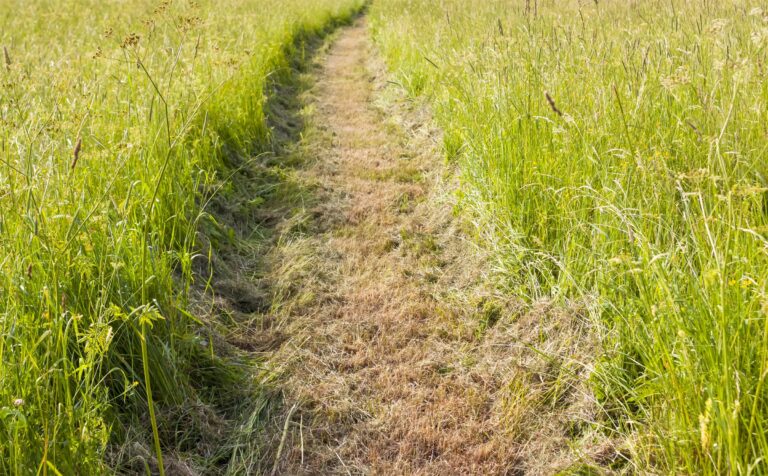 Paths worn between a gate and a shed compact the soil until roots cannot push through. Water then runs across the surface instead of soaking in.
Compaction shows up as a hard, flat area where the blades stay short and pale instead of browning off. Aeration relieves it, but only if the traffic pattern changes too.
Low spots hold water after our heavy rain, and roots sitting in saturated soil rot. The opposite problem shows up along driveways, where reflected heat dries the strip faster than the rest of the yard.
Walk the yard an hour after a storm and mark anything still holding water. Those marks usually line up with your bare patches.
Not every bare spot is a site problem. Two insects and one fungus cause most of the sudden damage we are called to fix.
Chinch bugs attack St. Augustine in the hottest, driest, sunniest part of the yard, often along a south-facing drive. The damage starts as a yellowing patch that spreads outward and does not green up after watering.
The AgCenter confirms them with a soap flush: stir a tablespoon of lemon-scented dish soap into a gallon of water, pour it over the grass at the edge of the damage, and watch for five to ten minutes. Treating early keeps the area small, because scattered patches merge into one large dead area as the insects spread.
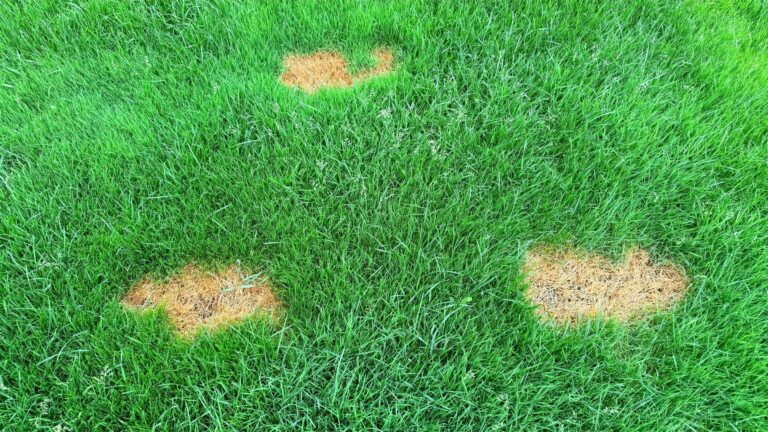 Brown patch, which the LSU AgCenter now calls large patch, forms irregular or circular patches in spring and fall rather than in the heat of midsummer. It runs when nighttime temperatures sit between 60 and 75 degrees and the blades stay wet.
The affected leaves pull off the stem easily, and St. Augustine shows a yellow cast at the leading edge of the patch. Watering early in the morning rather than late afternoon lets the blades dry, and that change costs nothing.
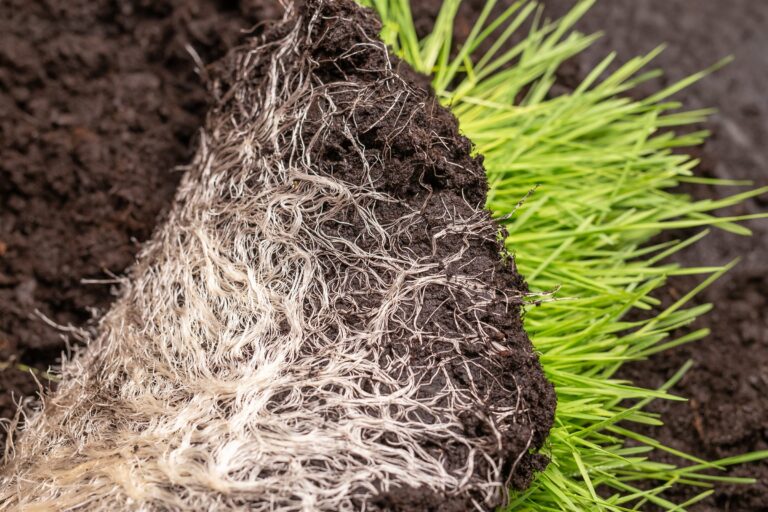
White grubs feed below the surface on the roots, so the turf yellows and then lifts easily when you tug it. Birds working the same area of the lawn over and over are often the first sign.
Check by lifting a square foot of turf at the damaged edge. If the roots are gone, replacing the grass without treating first just feeds the next generation.
For an area smaller than a few square feet, plugs are the cheaper and more reliable route. St. Augustine spreads by stolons, the runners that creep across the surface, so plugs gradually fill the bare ground between them.
You do not have to buy plugs. The LSU AgCenter notes that plugs can be cut from healthy turf elsewhere in the same lawn and moved into the bare area.
Take them from an out-of-the-way strip along a fence or behind a shed, then fill the holes left behind with soil. That donor area fills back in from its own runners within a few weeks.
 Set plugs 12 to 14 inches apart across the patch, the spacing the LSU AgCenter recommends for St. Augustine. Tighter spacing does establish faster, but it costs more material, and wider spacing drags the fill-in out.
Press each plug so its soil line sits level with the surrounding grade. A plug sitting above that line dries out, and a sunken one collects water.
New plugs need routine irrigation for the first 10 to 14 days while the roots move out into the surrounding soil. After that the AgCenter calls for longer, less frequent watering, plus up to half a pound of nitrogen per 1,000 square feet once the plugs have rooted.
Hold off mowing until the new growth is actively running and the plugs no longer shift underfoot. Our lawn cutting service can adjust height over a repaired area while it knits together.
Plugs work when the patch is small and the cause is fixed. Past a certain size, waiting months for runners to cover that much ground stops making sense.
Sod gives you a finished surface the same day, which matters on a front lawn or before an event. It costs more per square foot, and it still fails if the underlying problem is never corrected.
Use the comparison below to decide which route fits the area you are looking at.
| Situation | Better Option | Why |
|---|---|---|
| Patch under a few square feet | Plugs | Runners close the gap on their own at a fraction of the cost |
| Large area or full front lawn | Sod | Finished surface immediately, no waiting through a season |
| Worn path across the yard | Neither until traffic moves | New grass fails again unless the path is rerouted or paved |
| Deep shade under a mature tree | Bed or groundcover | Turf thins out where a canopy blocks the sun all day |
Where a yard has drifted past spot repair, our landscape restoration service rebuilds grade, drainage, and turf together. Repairing patches one at a time on a failing yard is money spent twice.
The repair itself is rarely the hard part. Reading the yard correctly is, because shade stress, chinch bug damage, and compaction can all look like the same brown spot from the porch.
At Big Easy Lawn Care, we walk the property, identify what took the grass out, and repair the cause and the surface in the same visit. Call us today to have your bare spots looked at before you spend money on seed or turf that will not hold.
A patch that returns after replanting means the cause was never removed. Shade, compaction, a buried slab, poor drainage, or an active insect population all survive a turf swap. Diagnose the spot first, correct the condition, then replace the grass so the repair holds.
Plugs are the standard repair for small areas. Cut or buy plugs, set them 12 to 14 inches apart across the bare ground, press them level with the surrounding grade, and keep them watered while roots establish. The runners then spread and close the gap on their own.
It can, if the patch is small and the cause is fixed. St. Augustine spreads by stolons, the runners that creep across the surface, so healthy grass at the edge slowly covers the gap during the growing season. Large patches, or spots where shade, compaction, or insects remain, usually stay bare until you plug or sod them.
Chinch bugs are a common cause in hot, sunny areas, producing yellowing that spreads outward and does not recover after watering. Brown patch fungus creates irregular or circular patches in the milder, wetter weather of spring and fall. Drainage problems and nutrient shortfalls also show as yellowing, so check the soil before treating.
Expect much of a growing season for plugs spaced 12 to 14 inches to knit together, with visible spread within several weeks. Warm weather, steady moisture, and light feeding speed it up. Cool weather slows the runners considerably, so spring and early summer plantings close fastest.
Aeration helps when compaction is the cause, which shows as hard, flat ground where grass is short and pale rather than dead. It does nothing for shade damage, insect damage, or disease. Identify the cause first so you are not aerating a problem that aeration cannot reach.
Plugs suit small areas and cost far less, while sod suits large areas or anywhere you need a finished surface immediately. Both fail if the underlying cause is untouched. Match the method to the size of the area and to how quickly the space has to look complete.
In Louisiana, plugs and sod can go in any time during the growing season, which runs roughly March through October. Spring through early summer is the safest window, because it leaves the most time to establish before winter dormancy. Drainage or shade fixes can happen any time of year, so correct the cause first.

 By
BigEasyLawnCare
By
BigEasyLawnCare  Sep 14, 2026